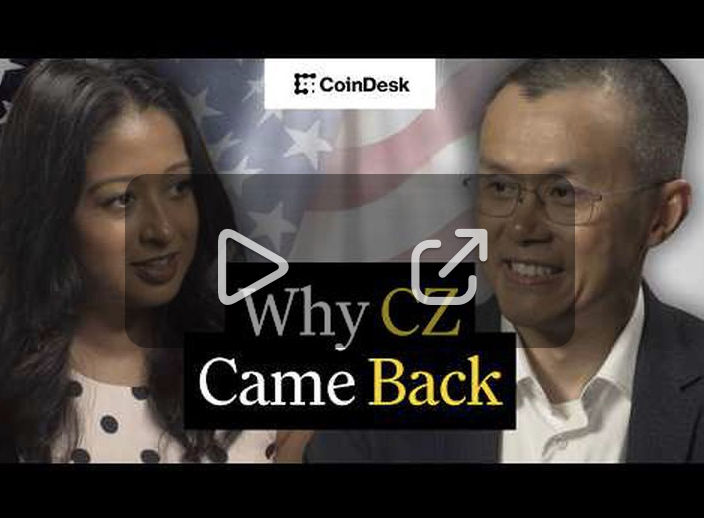
Our exclusive sit-down with CZ on freedom, prison, and the future of money.
CoinDesk Spotlight
Exclusive Interview
A Conversation With Changpeng Zhao
CZ on freedom, prison, and why he's betting on America again
In a rare, wide-ranging sit-down, the Binance founder opens up about the meaning of financial freedom, the four months that changed him, where AI and crypto collide next, and why he's done staying away from the U.S.
“The U.S. Constitution is actually an extremely good white paper.”
— CZ
What He Told Us
Two kinds of freedom
CZ draws a sharp line between financial freedom — having enough to live the way you want — and freedom of money, the right to spend, send, receive, and invest without gatekeepers. The first, he argues, is within reach for anyone willing to live frugally. The second is where most of the world is still stuck: billions of people with a phone and a connection but no access to the financial tools Americans take for granted. Closing that gap, he says, not chasing the next price spike, is still what drives him.
Why he's betting on America again
After his prosecution under the previous administration, CZ admits he wanted to stay as far from the U.S. as possible — a year and a half ago he wouldn't have sat for an interview on American soil. What changed his mind was watching the country correct course. He now describes the Constitution as a system brilliantly built to self-heal, and credits that resilience for America's role as the world's economic and policy leader. His goal now: help make the U.S. the capital of crypto — and fix the fact that, in his view, U.S. consumers still pay some of the worst prices in the world to buy and sell crypto.
AI and crypto are about to collide
His clearest conviction is about where AI and crypto meet. Today an AI can find your flight but can't buy it — the moment agents can transact, he argues, they'll do it on crypto rails, making financial infrastructure for machines one of the biggest demands on the horizon. He's already watching the lines blur: people are buying AI stocks with crypto, and in his view crypto shouldn't be its own industry any more than “the internet” is. It's foundational plumbing every other sector will eventually run on.
On the hype — then and now
He's blunt about 2022: the industry got drunk on its own story, the way the dot-com era did before it. He expects AI to run the same cycle — an overpriced peak, a crash, and steady growth underneath it all. The upside for crypto, he says, is that the speculative money has largely rotated into AI, leaving the long-term builders behind — a healthier base, even if prices don't moonshot overnight. On the CLARITY Act, he's measured: important, but a tactical milestone, not the thing that decides the industry's trajectory over five, ten, or twenty years.
Four months, a book, and what he saw
CZ wrote much of his book, Freedom of Money, behind bars, in 15-minute increments grabbed between routines. The first draft, he says, came out angry — full of blame — and the real work was subtracting it, coming to terms with what happened and letting it go. The experience exposed his blind spots (he admits he never learned enough about legal and compliance, and it cost him) and his strengths (a calm, almost stoic temperament he credits for steadying his teams). He has since donated roughly $2 million to Prison Professors, a nonprofit run by a man who served 26 years, and says plainly that many of the people he met inside should never have been there.
Life after running Binance
Still the single largest shareholder, CZ no longer runs Binance day to day — and says he doesn't want to. By his own account, the company may execute better without him. His wealth remains overwhelmingly in BNB, and his focus has shifted to early-stage founders, where small teams move fast. He's a zero-to-one person, he says; the weekly status meetings of a large organization were never his thing.
The full conversation goes deeper.
Hear CZ in his own words on security in 2026, advice to founders, and what he'd tell the 12-year-old who landed in Canada.